

A dying ash beside the house in Chatham, a row of overgrown trees along a farm drain near Ridgetown, or a neighbour's maple leaning over the fence in Wallaceburg all raise the same question: is there a tree removal bylaw Chatham-Kent property owners need to follow before cutting? The short answer is that the municipality does not regulate trees on private property, but that is not the whole picture. Road allowances, hydro lines, municipal drains, endangered species, nesting birds and shared boundary trees all come with their own rules. This article walks through each one so the job is done safely and legally the first time.
Key Takeaways
- Chatham-Kent has no bylaw governing trees on private property, so most homeowners do not need a municipal permit.
- Trees along municipal roadways are maintained by Public Works, and trees near hydro wires are handled by the hydro provider.
- Trees along municipal drains fall under Ontario's Drainage Act, so the Drainage Department should be part of the plan.
- Butternut, black ash and active migratory bird nests are protected by provincial and federal law even on private land.
- A tree growing on the property line belongs to both neighbours and should not be removed without agreement.
Is There a Tree Removal Bylaw in Chatham-Kent?
No. The Municipality of Chatham-Kent states that there is no bylaw to govern trees on private property. That makes Chatham-Kent different from many Ontario cities, where removing a mature tree from a backyard can require a permit, an arborist report and replacement planting.
The lack of a Chatham-Kent tree bylaw does not mean every tree can be cut without a second thought. The tree's location, its species and whether birds are nesting in it can all bring other laws into play. Goodreau Tree Care's ISA Certified arborists check these points on site before any removal, which is usually when an exception first comes to light.
Chatham-Kent Tree Rules for Private Property
For a tree growing fully on private land, the decision to remove it rests with the property owner. The practical rules below still apply whether the property is a town lot or a working farm.
Homes in Chatham, Wallaceburg and Smaller Communities
On a typical residential lot, cutting trees on private property in Chatham-Kent does not require a municipal permit. The checks that matter are whether the trunk sits fully inside the property line, whether the tree is a protected species, and whether there is an active nest in it. Large trees close to houses, garages or fences are also a safety question: a mature silver maple or oak can weigh several tonnes, and a removal near a roof often needs rigging or a crane rather than a single cut at the base. Goodreau Tree Care handles this kind of work through tree services in Chatham and nearby communities such as Wallaceburg.
Rural Woodlots and Farm Fence Rows
Rural landowners have seen the rules change in recent years. In 2021, council approved a temporary bylaw banning the clear-cutting of woodlots, which was later extended. In September 2023, council voted to repeal it, so there is currently no Chatham-Kent woodlot bylaw restricting tree clearing on farmland.
The municipality has also reported that tree cover dropped from 3.87 per cent in 2010 to 3.54 per cent in 2020, and woodlot clearing remains a topic of local debate. Landowners planning larger clearing of fence rows or windbreaks should still check for endangered species and municipal drains before work begins, and consider stump grinding where cleared rows will be farmed.
Trees on Municipal Roadways and Public Land
Chatham-Kent Public Works maintains trees along municipal roadways, with safety along the right-of-way as the first priority. Dangerous, damaged or diseased municipal trees are trimmed or removed by the municipality, not by residents. In 2026, the municipality also began a proactive maintenance program for municipally owned trees, covering dead, diseased or damaged branches and clearance over roads, sidewalks, driveways and rooftops.
Trees Overhanging the Road Allowance
A tree on private land can still affect the road. The municipality notes that private trees extending into road allowances may need pruning for traffic and pedestrian safety. Regular tree pruning keeps limbs clear of the road, mailboxes and passing farm equipment before it becomes a municipal concern.
Trees Near Hydro Lines
Public Works does not prune trees along hydro wires. Concerns about trees near lines go to the hydro provider, which in Chatham-Kent is Entegrus or Hydro One depending on the area. Homeowners should never prune or fell a tree that is touching or close to a line themselves. Work near energized lines calls for crews trained in utility and power line clearance, coordinated with the utility.
Trees Along Municipal Drains
Municipal drains are a big part of the Chatham-Kent landscape, with roughly 4,100 drains covering about 4,000 kilometres. Ontario's Drainage Act requires the municipality to maintain and repair these drains, and the Drainage Department manages that work.
For tree removal near a municipal drain, it pays to speak with the Drainage Department first, since trees in a drain's working space may already be part of planned maintenance. Provincial guidance for drain maintenance also stresses keeping the root structure on side slopes to preserve slope stability, so trees on drain banks are often cut close to the ground rather than pulled out by the roots. Goodreau Tree Care is a member of the Drainage Superintendents Association of Ontario and provides vegetation management for drains, ditches and rural rights-of-way.
Endangered Species Rules for Trees in Chatham-Kent
Chatham-Kent sits in Ontario's Carolinian zone, home to several tree species found almost nowhere else in Canada. Provincial species-at-risk rules apply on private land regardless of local bylaws.
Butternut and Black Ash
On March 30, 2026, Ontario's Endangered Species Act, 2007 was repealed and replaced by the Species Conservation Act, 2025. Butternut and black ash remain covered under the new framework, which sets out specific requirements for activities involving unhealthy butternut or black ash trees. Butternut is often confused with black walnut, and black ash is easy to mistake for other ash species, so correct identification is the first step before any butternut tree removal in Ontario.
Nesting Birds and Removal Timing
Under the federal Migratory Birds Regulations, 2022, migratory birds are protected at all times and most nests are protected when they contain a live bird or viable egg. Environment and Climate Change Canada recommends checking nesting calendars when planning work. Late fall and winter are a practical time for planned removals: leaves are down, nests are easy to spot and most nesting has ended. Dormant-season work also fits naturally into preparing a home for spring in Southern Ontario.
Neighbour Trees in Chatham-Kent: Ownership and Consent
Neighbour disputes over trees are common in older Chatham-Kent neighbourhoods, where mature trees were planted long before fences and lot lines were surveyed. The key question is where the trunk stands.
Boundary Trees on the Property Line
Under Ontario's Forestry Act, a tree whose trunk grows on the boundary between two properties is the common property of both owners. A boundary tree in Ontario should not be removed or seriously injured by one owner without the other's agreement. Written consent and a survey showing the trunk location help avoid disputes later.
Overhanging Branches and Roots
When the trunk is fully on one property, the tree belongs to that owner even if branches or roots cross the line. In Ontario, a neighbour can generally trim overhanging branches back to the property line, provided the work does not kill or seriously harm the tree. Heavy cuts on one side can unbalance a tree, so a tree health inspection before major pruning protects both properties.
Before You Cut: A Simple Checklist
A few quick checks prevent most problems with tree removal in Chatham-Kent:
- Confirm the trunk location. Make sure the trunk is fully on private land and not on a road allowance or shared property line.
- Check for drains and hydro lines. Trees near municipal drains involve the Drainage Department, and trees near wires involve the hydro provider.
- Identify the species. Butternut and black ash need extra steps under provincial rules.
- Look for active nests. Leave nests with eggs or young undisturbed until the birds have finished.
- Talk to the neighbour. Get agreement in writing for any boundary tree.
- Get the tree assessed. A certified arborist can confirm the safest removal method or whether pruning or cabling could save the tree.
When to Call a Certified Arborist in Chatham-Kent
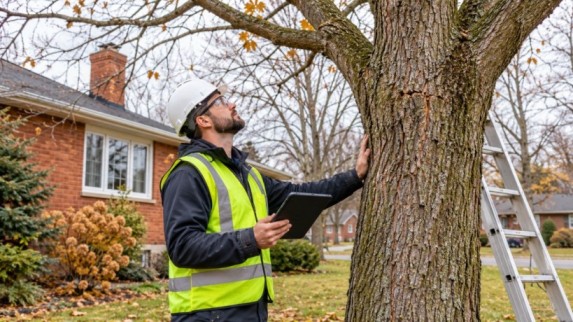
Not every tree that looks unsafe needs to come down. Crown reduction, structural pruning or cabling can often keep a sound mature tree standing, and healthy trees can boost property value and help cut home energy bills through summer shade. When removal is the right call, a trunk crack, root lift, heavy lean or fungal growth at the base are signs it should be done promptly by a professional.
Goodreau Tree Care is based in Chatham-Kent and has served southwestern Ontario for over 40 years. Its fully insured crews provide professional tree removal, crane-assisted removal, stump grinding and 24/7 emergency service, and every job starts with a free, no-obligation estimate. To book an assessment, request a free estimate or call (519) 682-1818.
Frequently Asked Questions
Do I need a permit to cut down a tree on my property in Chatham-Kent?
No. Chatham-Kent has no bylaw governing trees on private property. Endangered species, active bird nests and shared boundary trees still need extra care.
Can I clear trees from a woodlot or fence row on my farm?
Yes. The temporary woodlot clearing bylaw was repealed, so no municipal permit is needed. Check for protected species, nesting birds and municipal drains before clearing.
Who removes a dangerous tree along a Chatham-Kent road?
Chatham-Kent Public Works trims or removes dangerous, damaged or diseased trees along municipal roadways. Residents can report them through the municipality's service request.
Can my neighbour cut branches hanging over my yard?
Generally yes, back to the property line, as long as the work does not kill or seriously harm the tree. A tree growing on the property line needs both owners' agreement.
Can I remove a butternut tree in Chatham-Kent?
Not without following provincial species-at-risk requirements. Have an arborist confirm the species and the tree's health first.
Blog Articles


Need our help?
Get a quote


goodreautreecare@outlook.com
Your message has been sent.
Please try again, or email us directly at:
goodreautreecare@outlook.com